
If you are considering selling your practice, understanding the financial side of the sale matters. It is how you make sure you are maximizing value and planning for what comes after. For a dermatologist partnering with an MSO, the valuation is typically divided into two parts: cash at close and equity in the MSO’s platform. Several other numbers then decide what you actually keep, including your debt, how the deal is taxed, and what you do with the proceeds. Here is how those pieces fit together, using one example.
A Valuation Prices the Practice, Not What Goes In Your Bank Account
So, how is your practice valued and why isn’t it all cash? A valuation is built on enterprise value, which is a multiple applied to your earnings before interest, taxes, depreciation, and amortization (EBITDA). It is the price of the whole business. Most MSOs will ask you to reinvest part of the price as equity. It shows you believe in the platform and keeps you invested in the practice’s results after closing, and because the MSO pays less cash up front, it takes on less risk in the deal.
Take a hypothetical practice with $2.5 million in EBITDA that sells at 8x. Enterprise value is $20 million. The owner has $1.5 million in debt and rolls 20% of the price, or $4 million, into equity in the MSO.
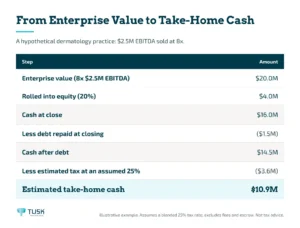
At the end of the day, you are netting a little over 50% of the deal’s value in cash after debt and estimated taxes, before fees and escrow. The debt piece is very important to understand. Many dermatologists are not aware that deals require all business debt to be paid off at the time of sale, and it comes out of your cash, not your equity. You are also allocating $4 million into equity, which ideally returns 2x to 4x by the time of the recapitalization. Because debt is paid first, that $4 million is about 22% of the $18.5 million you own after debt, so you are reinvesting more of your real equity than the 20% suggests.
These figures are illustrative. Your practice, entity type, and state will change them.
How Deal Structure Impacts What You Take Home vs. What You Owe
Most of the price is generally taxed as long-term capital gain, which carries a top federal rate of 20% in 2026, plus state tax. Not all of it qualifies. Amounts the purchase agreement allocates to equipment, a non-compete, or consulting can be taxed as ordinary income, which is higher. If your practice is a C corporation, the sale can also be taxed twice, once in the company and again when you take the money out. S corporations and partnerships generally avoid that.
Depending on your entity, there are ways to improve the result: how the price is allocated, whether part of it is paid for personal goodwill (which generally requires that you have no non-compete with your own practice), how deferred payments are structured with stated interest, and which year the deal closes.
Where you live matters as much as how the deal is structured. Using the same example, the $14.5 million in cash after debt is taxed very differently by state. The figures below apply the 2026 top federal long-term capital gains rate of 20% plus state tax, and assume the full amount is capital gain.
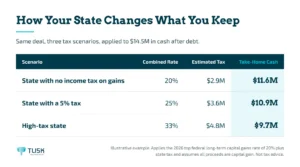
Anything allocated to equipment or a non-compete is taxed as ordinary income, which pushes these numbers up, and your entity type and basis can move them further. That is why your CPA should model your own scenario before you sign a letter of intent.
Debt works differently. The interest and depreciation on what you borrowed already reduced your taxes in prior years. At closing, debt is repaid from proceeds, so it lowers your cash, not your tax bill. Check the prepayment terms on your loans early.
These decisions are hard to change once a letter of intent is signed, so bring your CPA in before then.
What Happens To Your Equity In A Recapitalization
In a typical private equity-backed deal, most of the price is paid in cash at close, and the rest is rolled into equity.
Is that equity taxed when you sell? It can generally be structured so you are not taxed when you roll it. You pay tax on the cash at close, and the rolled portion is taxed when you eventually sell it. If your practice is an S or C corporation, getting there often requires a reorganization before closing, which is another reason to plan early.
You cash in on that equity at the next liquidity event, usually when the platform is sold or recapitalized again several years later. In our example, if the platform’s equity value grows 1.5x, your $4 million becomes $6 million, before dilution and before any investors with preferred returns are paid first. It can also be worth less.
Owners are attracted to equity because it lets them take chips off the table now and still participate in what comes next. The buyer, an MSO in this scenario, is building a larger platform, adding practices, and growing earnings, and your equity shares in that growth. When the platform is recapitalized or sold, your stake is valued at the bigger platform’s price, which is where the extra return comes from. It also keeps you aligned with your partner, since you do well when the platform does well. Equity still carries risk and can lose value, so it deserves its own review, but the appeal is easy to understand.
What To Do With The Cash From Selling Your Practice
What do you do with your millions? An order that works for many owners: set aside your tax reserve first so it is not spent by accident, pay off personal debt, and hold enough liquid cash for your near-term needs. After that comes the larger question of diversification. For years, your net worth has been tied to one asset, and the equity keeps a portion of it there, so plan the cash you take with that in mind.
At TUSK, we work alongside your CPA and wealth planner so the terms of the deal fit what you want over the next five to ten years, whether that is retirement, generational wealth, or funding your next venture.
If you’re curious how you can maximize the value of your practice sale, I would start the conversation early with an experienced broker in the dermatology industry. At TUSK, we provide your practice’s financial analysis for free any number of times with several different models so that you can understand what every possible scenario looks like. To receive one of TUSK’s complimentary dermatology valuations, please visit here, and submit the form to get the conversation started.
Frequently Asked Questions
How much money do I keep after selling my dermatology practice?
How much money you keep after selling a dermatology practice depends on four things: the debt repaid at closing, the tax on your cash, how much of the price you roll into equity, and fees and escrow. In our example, a $20 million enterprise value produced roughly $10.9 million in take-home cash, with $4 million rolled into equity. Your numbers will differ.
Is the equity in a dermatology sale taxed when I sell or only during the recapitalization when I cash in?
The equity in a dermatology sale can generally be structured so it is taxed when you cash in at the recapitalization, not when you roll it at the closing table. Cash you receive at close is taxed in the year of the sale. Whether deferral is available depends on your entity type and how the deal is structured, so confirm it with your CPA and attorney.
What should I do with the money after I sell my dermatology practice?
What you do with the money after you sell a dermatology practice should be planned before closing. Set aside your tax reserve, pay off personal debt, hold liquid reserves, and then build a diversified plan with your CPA and wealth planner.