
I get it. You get an offer that feels like it checks all the boxes, but you are left not knowing what other buyers are willing to put on the table.
Most plastic surgeons I talk with want the right partner, a structure that fits their goals, and a fair outcome for a business they spent decades building. With only one offer in hand, though, there is no way to know whether you are getting any of that.
Selling to the first buyer who makes a reasonable offer for your practice costs you more than you know; the most important of which are leverage and optionality.
What does a single buyer control in your sale?
With one buyer, you’re handing over the reins to almost everything. Money isn’t the only thing that is a part of the sale. You’re also negotiating your employment agreement, real estate terms, benefits, non-competes, and much more.
Competition changes the conversation. When several offers are on the table, your advisor can go back to one buyer and say, “Buyer B has increased their multiple by a turn. If you want to stay competitive in this process, we need to see a change in your offer.” They can also say “Buyer A is willing to shorten the employment period from 5 years to 4; what can you do?” That request is specific, and it carries weight because it is true.
Buyers respond. We regularly see them go back, reformat their offer, and sharpen it to compete with the others at the table, often on terms well beyond price. None of that happens without the other offers. As your advisor, our role at TUSK is to manage the push and pull between you and the buyers at the table to get you the right deal.
Why does every buyer’s offer look different?
Every buyer does deals differently. Each one has terms where it can be pushed and terms where pushing strains the deal. One buyer may offer the highest price but tie part of it to an earn-out based on collections. Another may pay less but deliver more at close, with no earn-out and a simpler structure. A third may offer meaningful equity participation alongside a management fee that changes what you keep each year.
In the 200+ transactions TUSK has negotiated, we are always taking the offers on the table and going back to the buyers with amendments because the best offer on paper is not always the best offer for you. Knowing where each buyer can move, and where moving breaks their model, is where an advisor adds the most value.
What does optionality actually give you?
It gives you a point of comparison. With several offers in hand, you can hold buyers up against each other on an apples-to-apples basis and see where each one stands. That is optionality in practice: the ability to choose, with real information behind the choice.
At TUSK, we build that comparison for our clients. We lay out every offer you receive and compare them on risk profile, valuation, and deal terms, so you can see how they differ and where they are alike. Here is how three offers for the same practice can read once they sit on one page.
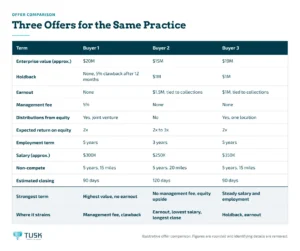
Each buyer in this comparison tends to fit a different kind of seller.
The surgeon who wants to keep practicing for the long term. Buyer 3 pairs a five-year term with the strongest salary and a 90-day close, though a holdback and an earnout tie part of the payment to performance. Buyer 1 offers the same five-year term with no earnout and no holdback, but the management fee and the 12-month clawback need a close look.
The surgeon who wants the most certainty at close. Buyer 1 offers the highest value with no earnout, which means more of the price arrives when the deal does.
The surgeon who wants to step back sooner and is comfortable with more risk. Buyer 2 has the shortest employment term and the strongest equity upside, but it pays the least and carries the largest earnout and the longest close.
None of these is the right answer for every surgeon. The comparison is what lets you decide which trade-offs fit your goals.
How do you evaluate the people behind the offer?
A deal is quantitative and qualitative, and a spreadsheet cannot tell you what it will be like to work with a group for the next several years.
That is why many of our clients visit buyer headquarters and have dinner with the different groups. You meet the people shaping the platform, hear how they talk about clinical autonomy and patient care, and see how they treat the surgeons already there. You learn quickly whether the culture described in a presentation matches the one in the room.
Having more than one group to meet makes those conversations more useful. You are no longer deciding whether you like one team. You are learning what a good fit looks like by seeing several.
Where to start
The first offer should be the beginning of your comparison, not the end of it. If you are thinking about a transition in the next few years, a valuation is a good place to see where your practice stands and which buyers could be a fit. You can start with our plastic surgery valuation so you can start seeing what a transition would yield you today.
Frequently Asked Questions
How many buyers should a plastic surgeon bring to the table?
A plastic surgeon should bring enough buyers to the table to create a real comparison, which means more than one and usually several. The right number depends on the size of the practice and the type of partner that fits your goals, and the list should be built around fit rather than volume. TUSK Practice Sales brings our clients an average of 6 offers to the table.
Will buyers change their offer when they know others are competing?
When you work with a broker, it is their job to negotiate with buyers to modify their offers to fit more of what you’re looking for. We regularly see them revise structure, terms, and price to stay competitive, which is why having offers side by side matters more than any one number.
Does running a process put my practice's confidentiality at risk?
Running a process does not have to put your practice’s confidentiality at risk. Buyers are approached under confidentiality agreements, and information is shared in stages, so your team, patients, and referral sources are not alerted before you decide.