


Why the Best Year for Your Practice May Be the Worst Time to Wait
You just had the best year your practice has ever seen. Collections are up, the schedule is packed, and the thought of selling doesn’t even cross your mind. Why would it?
If you’re early in your ownership journey (five, ten, even fifteen years in), that instinct is likely correct. Owning a practice for the long haul, even through rough patches, can generate more wealth than selling early and spending decades as an associate. Ownership compounds. The long game wins.
But if you’re within seven to twelve years from beginning to scale back, the calculus changes entirely. What feels like your strongest position could actually be a closing window.
I write this wearing two hats: as an experienced M&A advisor for the last six years, and as a dental practice owner alongside my spouse, who is a practicing dentist. The dynamics described here aren’t abstract to us. We’ve lived them firsthand, which is why I want to share what we see every day across the practices we advise.
The Five-Year Number That Changes the Math
In today’s dental M&A market, premium offers almost universally require the selling clinician to remain in the practice for approximately five years after the transaction. Buyers are purchasing patient relationships and clinical continuity, and the best multiples go to sellers who commit to a meaningful transition.
This means that if you want to stop practicing at 62, you need to be transacting at 57 if you want the best outcome. And to transact at 57 from a position of strength, your practice needs to be growing at ages 54, 55, and 56. Work backwards from when you want to be done, subtract five years, and add 3 years of requisite growth, and you are looking at an 8-year off-ramp for an ideal exit.
The Trap Is Comfort, Not Crisis — For Your Practice
Very few people consider a sale during a great year. You’re too busy growing, reinvesting, hiring, and expanding. The momentum feels permanent. Five strong years in a row trains your brain to expect a sixth.
That’s the problem. When revenue is climbing, the thought of exiting doesn’t register.
There is very little heads-up before a down year, only proof in the decline. New patient volume softens. An associate leaves. Insurance reimbursements tighten. A competitor opens two miles away, or an existing competitor begins accepting insurance. Individually, none of these are likely to be catastrophic. Together, they push the trend line down and that can be all it takes. The practice that would have commanded a premium twelve months ago is now a different conversation entirely.
The Trap Is Comfort, Not Crisis — For the Market
Your practice isn’t the only variable that can change. The market can, too, and has.
Today, the dental M&A market is active. Well-capitalized buyers are competing aggressively for quality practices, and that competition is what drives premium valuations. When five buyers are lined up for your practice, they bid against each other. That’s leverage. That’s how top-of-market deals happen.
But five buyers today does not guarantee five buyers two years from now. Buyer appetite shifts. Credit markets tighten. Platforms hit saturation in certain geographies. Strategies change. The capital that is flowing freely into dental acquisitions today is not a permanent feature of the landscape. It’s a real-time dynamic ecosystem.
Dentists often assume the market will be there whenever they’re ready. The reality is that you can do everything right with your practice and still get a worse deal simply because the market cooled while you were waiting. Markets move in cycles, and if doctors wait until the last possible moment to sell, the option to wait for the market to come back is no longer on the table.
The Costly Irony of Holding On
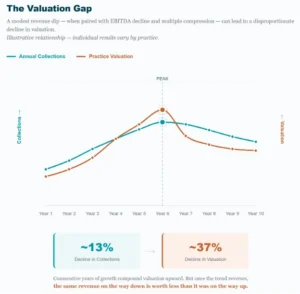
Now put both traps together. A dentist at 54 has a thriving, growing practice in a hot market. Five buyers would compete for it today. They could sell at peak value, lock in a premium multiple, and spend the next five years practicing with less overhead, better resources, and a liquidity event already in the bank. Done at 59.
Instead, they wait. Three years pass. Growth stalls. Burnout creeps in. And the market has shifted: two of those five buyers have paused acquisitions in the region, and the remaining three have more leverage. The dentist finally explores a sale at 57, but the practice is valued meaningfully below its peak, and the competitive tension that would have driven the price up is gone. They accept a lower offer and commit to five more clinical years on top of it. Now they’re working until 62. Less money. More years. Worse terms. Entirely avoidable.
A Pattern We See Firsthand
There is a quiet validation of this thesis playing out in real time across completed transactions. We are seeing sellers who transacted at or near their peak, and who were confident at closing that continued growth would carry them through their earnout, fall short of those targets.
These were owners who genuinely believed the growth would continue. It didn’t. And here’s the counterintuitive takeaway: missing an earnout after selling at peak is still a far better outcome than waiting, watching the decline happen on your watch, and selling at a lower base with no earnout upside at all. The sellers who “left money on the table” by missing an earnout still captured more total value than the sellers who waited for a better day that never came.
Selling from Strength Isn’t Giving Up, for Some, it’s Doubling Down
Many of the best deals today aren’t full exits. Sellers are rolling over roughly 50% of their equity into the acquiring platform, meaning they monetize half of what they’ve built at peak value and then ride the second wave of growth alongside a well-capitalized partner. Selling at your strongest isn’t walking away. It’s locking in the upside you’ve already earned while betting on even more with less administrative burden, stronger operational support, and the freedom to focus on the clinical work & patients.
Who you partner with matters as much as the cash you receive at close. On any given opportunity, there may be 50 buyers who express interest. We’d bet on maybe 15 of them. The rest look good on paper, but not all buyers deliver the same post-transaction experience & results. Some have strong operational teams, proven integration playbooks, and a track record of supporting their clinicians. Others don’t. An advisor who knows these organizations from the inside, who’s seen how they treat their doctors after the ink dries, ensures the right buyers are at the table.
 The Question Isn’t Whether to Sell
It’s whether a sale can achieve your life goals. A confidential valuation costs you nothing but an hour. When a valuation is paired with proper financial planning, it can give you clarity on what the future looks like based on today’s performance & market, and five years down the line. This clarity enables you to make an informed decision on what is likely the largest transaction in your career, on your terms, at a time that ensures the best outcome.
You’ve spent decades building something valuable. The worst thing you can do is let the peak pass without ever knowing it was there.
Ready to find out what your practice is worth?
TUSK Practice Sales works exclusively with healthcare practice owners navigating the most important transaction of their careers. Our process is confidential, our valuations are data-driven, and our only objective is to maximize each client’s life’s work.
Contact TUSK today for a confidential, no-obligation valuation.
About the Author
 Alex Cherniavsky is Managing Director and Partner at TUSK Practice Sales, the premier advisors for dental and healthcare practice transactions. A dental practice owner himself, alongside his spouse, Alex brings a firsthand understanding of the decisions, pressures, and opportunities that practice owners face. Alex previously served as a Senior Financial Analyst for Wendy’s Corporation and valued over $750M of M&A transactions before joining Galt & Company where he co-developed innovative valuation models that supported a $10B dollar re-franchise sale of a Fortune 100 company’s production and distribution businesses.