In 2005, 85% of American dentists owned their practice. DSOs were just getting their start, but doctor-to-doctor transitions were much more common and comfortable for dental practice owners.
That was over 20 years ago, and today’s environment is noticeably different. I was scanning through the latest update from the ADA’s Health Policy Institute and reflecting on recent conversations with docs, and the reality is that the doctor-to-doctor transition path looks wildly different than it used to.
Here’s what I’ve learned:
- Fewer dentists own, and the ones who do are older. Ownership fell from 85% in 2005 to 73% in 2023. That is a steady slide rather than a blip, and it shows up hardest at the front of a career. Today 8.8% of dentists under 30 own a practice, and 32.5% of dentists between 30 and 34. Dentists aren’t becoming owners until much later in their careers.
- The newest cohorts are on a slower path. Among dentists who graduated between 2016 and 2020, 21% own a practice today. For dentists who graduated before 2010, ownership at the same career stage ran between 63% and 70%. HPI’s data shows those rates eventually converge around 15 to 19 years out, so this is more a delay than a disappearance.
- Graduating dentists start with more debt than any class before them. Dental school graduates in 2025 finished with an average of $297,800 in education debt, $280,300 of it from dental school alone. A lender reads that as a monthly payment. A $300,000 balance at 8% over 20 years is roughly $30,000 a year leaving the associates account before they make a single payment on your practice. Specialists carry more, since residency tuition at a program like NYU runs about $78,854 a year and cost of attendance at a public program like Pitt runs between $99,798 and $121,396 a year.
- Federal loan caps took effect July 1, and they make the next decade harder. The One Big Beautiful Bill Act capped federal borrowing for professional degree programs at $50,000 a year and $200,000 total, and began phasing out Graduate PLUS loans. Dental students who borrow federally averaged $95,455 in the 2024-25 academic year, nearly double the new cap, and roughly 72% of dental students rely on federal loans. Across a four-year degree, that is roughly $382,000 of borrowing need against $200,000 of available federal money. HPI found dental education has the largest gap between what students actually borrow and what the cap allows of any health profession. That money does not stop being borrowed. It moves to private lenders, where it is priced higher and offers no income-driven repayment. Students already enrolled keep the old limits for up to three more years. I do not think the market has adjusted to this yet, mostly because the first class affected has not graduated. This is mostly a warning sign to watch over the next 5 years.
- Group practice became the realistic alternative to ownership. Affiliation with a dental support organization more than doubled among American dentists, from 7.2% in 2015 to 16.1% in 2024. Among dentists within five years of graduation, it is 31%. Solo practice fell to 34% among dentists in 2024, and HPI notes that the decline occurred across every career stage. For a dentist carrying $300,000 in education debt, choosing that is a reasonable decision.
None of that is the part that surprises owners, though. Most doctors already sense that the pool of individual buyers is thinner than it was.
Where transactions actually fall apart
A dentist can want your practice and not be able to buy it.
Dental lending has a reputation for being generous. Practice loans default at very low rates, so specialty lenders have historically financed 100% of a purchase price and stayed comfortable with buyers carrying heavy student debt. Most transactions that get financed still get financed in full.
Approval is not always a yes or a no. If a bank funds 80% or 90% of the purchase price on a $1.2 million practice, the buyer, an associate in this case, has to bring $120,000 to $240,000 in cash to the closing table.
A few things can create that shortfall. The lender underwrites to its own valuation rather than the price you and the buyer agreed on, so if the appraisal comes in low, the loan sizes off the appraisal. The lender also looks at everything the buyer (associate) owes, and at some debt level the student loan payment starts reducing what a buyer qualifies for. And underwriters stress-test the cash flow at current pricing. Acquisition financing is running between 8.5% and 10.5%, with SBA 7(a) structures priced at prime plus 2.25% to 2.75%. At those rates, the same cash flow supports a smaller loan than it did three years ago.
What a funding gap costs you
For a dental practice, EBITDA (earnings before interest, taxes, depreciation, and amortization) is the number nearly every buyer other than an individual dentist will price from.
When a gap opens up, one of four things follows. The buyer produces the cash, which an associate five years out with $300,000 in student debt usually cannot. You reduce the price to what the bank will fund. You carry a note for the difference. Or the transaction dies, often after months of diligence and legal fees.
Owners tend to reach for the third option. Here is a practice doing $1.5 million in collections with $250,000 of EBITDA, priced at $1.2 million.
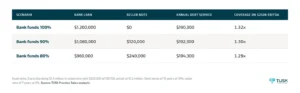
In the bottom row, you have lent 20% of your own sale price to your associate, you sit behind the bank in line, and you collect that last $240,000 over seven years with the expectation that the practice holds up.
The underwriter is already modeling what happens if it does not. If collections fall 10%, provider compensation and supply costs come down with them, but rent, staff, and equipment do not. EBITDA drops from $250,000 to roughly $167,500 and coverage falls from 1.32x to 0.88x. At that point the bank still gets paid. A subordinated seller note is the first thing to go quiet.
A DSO or private equity group finances this differently. The capital sits at the buyer level rather than depending on one dentist qualifying for a loan, so the transaction does not hinge on an individual appraisal or a personal guarantee. There is still diligence, there is still a quality of earnings review, and there can still be escrow or a holdback. But you are not being asked to fund the gap yourself. Pricing also works off an EBITDA multiple rather than a percentage of collections, and it often includes rollover equity, which can give you a second opportunity at a later liquidity event.
What this means for your plan
Below roughly $1.5 million in collections or $250,000 in EBITDA, the doctor-to-doctor market still works, and often works well. Price points sit inside what an associate can finance, funding gaps are small enough to bridge, and DSOs are typically not attracted to this asset.
At or above that level, you’re likely looking to partner with a DSO. The purchase price moves past what many individual buyers can finance without a gap, and you unlock the ability to create a competitive market between several DSOs.
A few things are worth doing regardless of which direction you lean.
Know what your dental practice is worth before you build a plan around a person, because that number determines which buyers can transact at all. If you want an internal successor, structure it as a partnership buy-in over time rather than one sale event, since smaller tranches are financeable at this size and a lump sum often is not. Ask your intended buyer whether they have been pre-qualified for the full amount or have only expressed interest, because those are very different things. And keep in mind that a DSO or private equity transition is not all or nothing. Rollover equity, retained clinical autonomy, and a multi-year post-close employment agreement let you monetize part of the practice, take chips off the table, and keep practicing.
Being realistic is not being pessimistic
There is one outcome nobody at TUSK wants to see, and it does happen. A dentist reaches the end of a long career, the one plan they had falls through, there is no time left to build another, and closing the doors starts to look like the only option left. A practice that took thirty years to build should not walk away for nothing.
That is the whole reason we run a practice valuation analysis. It maps your practice against each of the three real transition paths, doctor to doctor, DSO, and private equity, so you can see which are genuinely available at your size, in your market, today. The point is to show you the set of options you have.
If that would be useful, our team is happy to walk through it whenever the timing feels right for you.
Frequently Asked Questions
Can an associate dentist still buy a practice?
Yes. Most transactions that get financed get financed in full, and it happens routinely below about $1.5 million in collections. At or above that level, the financing required can exceed what a lender will approve for a single buyer carrying student debt, which leaves a funding gap the seller has to bridge.
What is a seller note in a dental practice sale?
A seller note is financing the seller provides to the buyer to close a funding gap. It is typically subordinated behind the bank loan, meaning the seller is paid only after the lender, and only if the practice continues to perform.
How much do dental school graduates owe?
Graduates in 2025 averaged $297,800 in total education debt, with $280,300 from dental school alone. Specialists who finance residency can carry substantially more.
Should I sell to an associate, a DSO, or private equity?
The right answer depends on your EBITDA, your timeline, whether you want to keep practicing, and how much of your proceeds you need at close versus later.