
If you own a behavioral health practice and you’re reading the 2026 headlines, you’re getting a mixed message. One story says capital is flooding back into the space and buyers are competing again. The next says deals are stuck and valuations are under pressure. Both are true, and that’s the thing owners have to understand about this market right now.
Buyers are scrutinizing service mix and payer mix more than ever, and it’s impacting the practices going to market.
Over the past year, I’ve watched two practices with identical revenue get very different receptions from buyers, not because one was run better, but because of who pays their claims and how predictable that money is. If you’re thinking about selling or partnering in the next couple of years, that’s the dynamic to plan around.
Capital Is Back, And The Numbers Show It
Let’s start with the good news. Behavioral health M&A had its most active year since 2022. Publicly announced transactions rose about 42 percent, to 104 deals in 2025 from 73 in 2024, according to deal tracking from Irving Levin Associates. Counseling and psychiatric care led the surge, with roughly 52 deals, nearly triple the year before.
The buyers behind it tell you something, too. The 2025 data shows strategic acquirers, the larger platforms buying to expand, posted the biggest year-over-year gains, roughly doubling their activity, while private equity add-on deals turned back up after a slide that had run since 2021. In plain language: the platforms are buying again, and they’re bolting on.
The macro read backs it up. PwC’s health services team has flagged behavioral health as one of the subsectors likely to see the most aggressive capital flows in years, with platforms commanding strong multiples on their scalability and the perceived direction of their reimbursement. PwC also noted the IPO window is beginning to reopen, which gives private equity a way to exit and clears the runway for more buying.
One honest caveat: even in a strong year, momentum cooled as it went. Quarterly deal counts declined through 2025. A good year doesn’t mean a hot finish, and it doesn’t mean the same practices will stay in demand from Q1 to Q4.
The Two Dividers Buyers Weigh First
Two dividers are shaping behavioral health M&A right now, and where your practice sits on each one does more to set your offer than your earnings do.
Inpatient vs. Outpatient
Start with the setting. Over the last decade, inpatient behavioral health facilities have drawn more scrutiny and, frankly, become less attractive assets, because of the operational and patient risk that comes with them. Most deal volume today is concentrated in outpatient. Within outpatient, TUSK has seen the strongest buyer interest in practices that pair traditional therapy with higher-acuity services: TMS, ketamine and Spravato, medication management, and intensive outpatient programs (IOP). That service mix produces consistent, sticky profitability, and buyers pay up for revenue that holds.
Payer Mix
The other side of the coin is payer mix, and specifically Medicaid. Medicaid is the single largest payer of substance use disorder services in the country, and 2026 arrived with a giant question mark over it. The reconciliation law passed in 2025, the One Big Beautiful Bill, is projected by the Congressional Budget Office to cut roughly a trillion dollars from federal Medicaid over the next decade. A RAND analysis published this February estimated state Medicaid budgets will shrink by about 664 billion dollars through 2034. The provisions owners fear most, work requirements and eligibility redeterminations, largely take hold by 2027.
Put yourself in a buyer’s seat. When a practice’s revenue leans heavily on Medicaid, the buyer isn’t only underwriting your earnings. They’re underwriting a payer whose budget is about to contract, in states that haven’t yet decided how they’ll absorb the cut. That’s a hard thing to model, and buyers price what they can’t model as risk.
Modeling Out The Impact
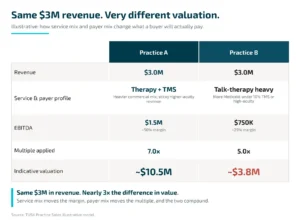
Two behavioral health practices can post the same three million dollars in revenue and be worth very different amounts. Say Practice A is an outpatient group pairing traditional talk therapy with TMS, with a diversified, commercial-leaning payer mix. Practice B, same $3M of revenue, offers mostly talk therapy, with less than 10 percent of revenue from TMS and a heavy concentration of Medicaid.
That difference shows up twice. First in profitability: Practice A turns its revenue into about $1.5 million of EBITDA, while Practice B, weighed down by lower-reimbursing Medicaid work and fewer high-acuity services, converts closer to $750,000 of EBITDA. Then it shows up again in the multiple. Practice A is likely to earn a 7x multiple, roughly a $10.5 million valuation. Practice B draws more scrutiny and a 5x multiple, closer to $3.8 million. Same top-line revenue, close to three times the difference in value. That gap is the buyer pricing risk, and most of it traces back to payer concentration and service mix.
It’s worth sitting on the single-payer problem, because it’s the one owners underestimate most. When one payer drives the majority of your revenue, a buyer isn’t really buying a business. They’re buying a bet on that payer’s next few decisions. A single rate cut, a contract renegotiation, a change in authorization rules, or a retroactive audit doesn’t dent one corner of the P&L; it moves the whole thing. There’s no pricing power to offset it and nowhere else for the revenue to go. And when that dominant payer is a government program, the decisions driving your revenue are being made in a state budget office, not across a negotiating table. Lenders see the same fragility the buyer does, so financing gets tighter and more expensive, which pulls the multiple down again. Concentration reads as fragility, and fragility is exactly what a buyer underwrites against.
What an owner can do now
- Diversify your payer mix where you can. Every point of revenue you move off a single dominant payer toward a balanced, commercial-leaning book makes you easier to underwrite.
- Get in-network where it strengthens you. In-network commercial contracts are a premium driver, not a nuisance.
- Reduce founder and single-clinician dependence. Buyers pay for a business that runs without you. Build the bench and document it.
- Clean up authorizations, denials, and compliance before diligence, not during it. The buyer will trim your accepted EBITDA for every soft spot they find.
- Know your own numbers by payer and by state. If you can’t show your payer mix and denial rates clearly, a buyer will assume the worst.
The bottom line
A strong market isn’t the same as a ready practice. Capital is genuinely back in behavioral health, and for the right profile, 2026 is a great year to have a conversation. But buyers are valuing downside first and growth second, and the two things that move your offer most are your setting and service mix and how your revenue is paid. If you’re interested in learning what your options are in today’s market, TUSK provides complimentary behavioral health practice evaluations that identify the active buyers in your market and determines your practice’s valuation. For more information, visit: https://tuskpracticesales.com/educational-resources/free-practice-valuation/
Frequently Asked Questions
Is 2026 a good time to sell a behavioral health practice?
For many owners, yes. Capital and buyer appetite are strong for mental health, autism, and commercially insured, scalable models. It’s a tougher market for Medicaid-heavy and substance use disorder practices while the Medicaid outlook is uncertain.
Why would two behavioral health practices with the same revenue get different offers?
Practices are valued on a multiple of EBITDA which range from 4x to 9x in today’s market. Payer concentration, reliance on one founder or a few clinicians, unstable authorizations, and compliance gaps all reduce the multiple a buyer will pay.
What is an MSO or platform?
Private equity typically buys through a platform company or a management services organization that provides the non-clinical infrastructure, such as billing, HR, contracting, and back office, and then adds on smaller practices. Understanding whether a buyer wants you as a platform or a bolt-on tells you a lot about how they’ll value you and what your role looks like after the deal.