
For a long time, the path of selling an orthodontic practice was fairly predictable. You either sold to an associate or partnered with an Orthodontic Service Organization (OSO) that valued your practice largely based on its size. Today, both paths look different. Fewer associates are in a position to buy, while OSOs are scrutinizing deals more closely.
The good news is that you haven’t missed your window. Buyers are still active, and well-run orthodontic practices are continuing to attract strong offers. But timing and preparation matter more than ever. At TUSK Practice Sales, we’ve advised on more than $1.5 billion in practice transactions across 250+ deals. Here’s how we see the orthodontic market today, what buyers are looking for, and how you can start preparing now to put yourself in the best position for a successful exit.
The Orthodontic Market Is Growing. Your Margin Isn’t.
On paper, orthodontics is one of the strongest growth opportunities in healthcare. Precedence Research projects the U.S. orthodontics market will grow from $6.27 billion in 2024 to $19.03 billion by 2034, representing an annual growth rate of 11.8%. By comparison, the overall dental market is projected to grow about 4.5% annually over the same period (Towards Healthcare). That means orthodontics is growing roughly 2.6 times faster than dentistry as a whole.
But strong market growth doesn’t necessarily translate to stronger practice profits. Since January 2021, hourly earnings for dental office staff have increased 23%, and dental equipment and supply costs have risen 23%. Meanwhile, reimbursement across all payer types has increased just 19%, falling short of the 27% rise in overall inflation (U.S. Bureau of Labor Statistics; ADA Health Policy Institute). Right now, most practices aren’t even keeping up with inflation. Put simply: You’re working harder than ever. And unfortunately, you’re making less money than you ever have before.
More Exams, Fewer Starts, Less Take-Home Pay
Here’s the paradox we’re seeing in orthodontic practices: demand is there, but it isn’t consistently turning into starts or stronger profits. New patient exams have been climbing, yet the American Association of Orthodontists’ 2025 Economics of Orthodontics survey puts the average exam-to-start conversion rate at 67%, flat for three years and below historical levels. I’d encourage owners to treat 70% as the floor and aim for 75% or higher. Sit down with your treatment coordinators and ask two questions: How many new patient exams are we seeing, and how well are we converting them? Every exam that doesn’t convert is marketing spend that never turned into production.
The pressure doesn’t stop at conversion. Average gross production rose from $3.93 million in 2024 to $4.12 million in 2025 (Gaidge), but net collections trailed net production by 4.1%, and gross collections among AAO members were essentially flat compared with 2022.
And what are practice owners actually taking home? AAO data shows average practice net income fell from $987,000 in 2022 to $847,000 in 2024, while the median rose from $550,000 to $650,000, which suggests the decline was concentrated among higher-earning practices.
If these numbers sound familiar, it’s because you’re feeling the squeeze firsthand. You’re seeing more patients, managing more staff, and spending more to keep your schedule full, but that effort isn’t necessarily showing up in your pocket.
What OSOs Look For In Orthodontic Practices Today
Before joining TUSK, I spent years on the buy side at a dental partnership organization, so I know how these groups think. Most OSOs and DSOs are backed by private equity firms that grow a platform through acquisitions, then aim to sell it within five to seven years for two to four times their investment.
That timeline is why buyers are still active. According to PitchBook’s Q1 2026 data, dental has more private equity platforms held past the typical exit window than any other healthcare segment: roughly 32 held for five to seven years and another 28 held for seven years or longer. Before those investors can sell, they need to show earnings growth, and acquiring strong practices is one of the fastest ways to get it.
Here’s what these groups prioritize when evaluating orthodontic practices.
Clean now sets the price
Four or five years ago, size was a primary driver of practice value, with practices generating $3 million or more in EBITDA commanding some of the strongest offers. Today, large practices still attract significant interest, but fewer buyers can afford them. Meanwhile, practices generating less than $2 million in EBITDA often face more competition because a wider pool of buyers can acquire them with less financial risk.
Regardless of size, buyers are looking closely at the fundamentals: clean financials, an owner willing to stay on after the sale, stable providers, and a payer mix that holds up under scrutiny. Practices combining orthodontics and pediatric dentistry can have an added advantage, as pediatric patients create a natural pipeline for future orthodontic treatment.
Scrutiny has never been higher
Due diligence is taking longer and going deeper. Deals that once closed about 45 days after a signed letter of intent can now take 60 to 90 days, and every adjustment to your earnings must hold up under a quality of earnings review. Buyers will also ask how long you plan to stay and whether your associate, team, and patients will stay too.
That’s why TUSK conducts its own thorough analysis before a practice goes to market, so your earnings are well-supported before a buyer reviews them and the value in the letter of intent holds through closing. A higher bar can also work in your favor: practices that come to market prepared stand out from those that can’t meet it.
Who Will Buy Your Practice When You’re Ready?
For many orthodontic practice owners, the plan has always been to sell to an associate. That path still works, but it’s harder than it used to be.
The biggest difference is debt. First-year dental school tuition rose 26.5% in-state, to $60,300, and 18.1% out-of-state, to $77,100, between 2017–18 and 2024–25 (ADA Health Policy Institute), and the AAO reports that orthodontic residents now graduate with an average of $567,000 in student loans. That’s before they borrow a dollar to buy your practice.
That debt is changing how lenders structure practice purchases. Banks increasingly ask sellers to finance 10–25% of the price through a seller note, which the buyer repays over time. We’ve seen firsthand how this can derail a transition. In one recent deal, the lender approved 80% financing and asked the owner to carry the remaining 20%. The owner declined, and the sale was pushed back another 18 months.
The profession itself is changing too. Women made up 34.8% of orthodontists in 2024, up from 12.6% in 2001 (ADA), and the AAO reports that 47% of women joined a DSO or OSO as their first job out of residency, compared with 20% of men. Among orthodontists aged 35 to 44, about 81% of men own their practices, compared with 48% of women, and 60–71% of orthodontists under 35 are employees. Many prefer a predictable income, a four-day workweek, and benefits over the risk of ownership.
None of this means an associate sale is out of reach. But relying on one buyer type can leave you with fewer options when you’re ready to exit.
Three Paths for an Orthodontic Practice Sale, and How Each Values Your Practice
There are three main paths for an orthodontic practice sale, and each values your practice differently.
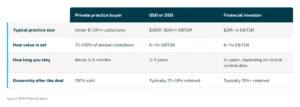
The valuation difference is where owners are most often surprised. A practice generating $2 million in collections might sell for roughly $1.5 million to $2 million in an associate sale. An OSO or financial investor, however, focuses more heavily on cash flow and profitability, meaning a highly profitable practice could command a significantly higher valuation. We’ve seen transactions reach two to three times collections when margins were strong.
But the offer price is only part of the equation. With an OSO or DSO, you might receive 60–70% of the value in cash, with the remainder tied to equity in the group. That equity’s ultimate value depends on the group’s future performance and eventual sale, making the quality of the partner just as important as the headline offer. I’ve seen owners receive offers far beyond what they expected, only to find that the terms didn’t adequately protect their interests over the long term.
What You Can Control Before Any Transition
You can’t control reimbursement rates or wage inflation. You can control how much revenue slips through the cracks, and that work pays off whether you sell next year or never.
Start with technology, but be selective. Every tool you pay for should lower your cost per patient, recover lost revenue, or reduce the labor behind each dollar of production.
Then look at your books. If your financials are reconciled twice a year instead of monthly, fix that first, and review your expense categories with your CPA at least quarterly. I always tell folks, you can’t save yourself to prosperity, but you can be knowledgeable and cognizant of your expense categories within your business.
Here’s what that looks like in practice. We referred a three-location orthodontic group for an expense review of eight categories, line items most owners dismiss as 1% or 2% of revenue. Insurance costs dropped 42%, health benefits 41%, internet 30%, and dental supplies 16%. Across all eight categories, expenses fell 23%, adding $158,627 a year to the group’s EBITDA and $475,881 over three years. The group went to market about six months later with that higher EBITDA and closed about a year after that.
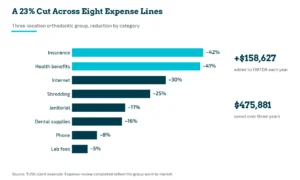
This is why expense work matters so much before a sale. Buyers pay a multiple of your EBITDA. At a 6x to 8x multiple, every dollar of recurring expense you remove can be worth $6 to $8 at closing.
How TUSK Helps You Exit on Your Terms
The orthodontic market still rewards prepared owners, but on stricter terms. Margins are tighter, buyers are looking harder, and the associate route asks more of sellers than it used to. The owners who come out ahead understand their options early and have someone in their corner when it counts.
That’s the role TUSK plays. As an exclusive sell-side advisor, we represent only practice owners, never buyers, so there’s no conflict of interest in any deal we run. Every client works with a dedicated deal team that reviews their financials, positions their practice with the right buyers, and negotiates value, terms, and structure. And we stay with you through closing, so the terms negotiated up front are the terms in your final documents.
Practice owners usually get one chance to sell in their career, and it should be done right. Whether your plan is a sale next year or a partnership five years from now, the decisions you make today shape the terms you get later. If you’d like an honest read on where your practice stands, reach out at [email protected] or visit www.TuskPracticeSales.com.