
Dozens of behavioral health platforms have formed over the last decade, which has been good news for practice owners. More buyers mean more options, and more options mean a real chance to find a partner that fits your practice, your patients, and you.
We know the sale of your life’s work is a big decision, and we know that not every behavioral health practice owner is going to be a good fit for a management service organization (MSO) or private equity group.
Some practices are better off staying independent.
But there is also real opportunity for owners to monetize their business, and when the fit is right, the partnership works, the two businesses add up to more than they did apart.
Finding that partner is our job at TUSK. It means testing every buyer for synergy with your practice in three places: financially, operationally, and emotionally.
Not Every Platform Is The Right Fit, Which Is Why We Vet Them
Our clients at TUSK routinely meet with anywhere from 4 to 15+ buyers when we take their behavioral health practice to market. These meetings can go several ways, but ideally they’re serving as an opportunity for you to learn more about them and vice versa. This is where practice owners are able to ask the hard-hitting questions from a variety of groups and truly make the first steps to finding the right match for your practice. We’ve spent years curating our buyer list to ensure our clients are seeing the full spectrum of buyer options; without it, owners are lucky to meet 1-2 buyers.
Here are the five things we check.
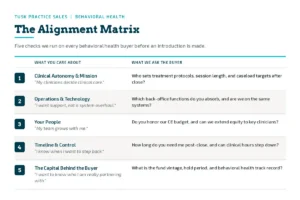
Check #1: Clinical Autonomy And Mission Integrity
This one is probably the most important question if you’re still clinical or are participating in setting up the clinical schedule.
- Who sets treatment protocols, session length, and caseload targets after close: your clinical leadership, or a central team?
- What is the buyer’s payer strategy for your market? Any plan to move out of network, enter/exit Medicaid, or renegotiate contracts changes who you’re able to treat.
- Which referral relationships depend on that payer mix? Hospitals, courts and probation, school districts. These take years to build and one contracting decision to lose.
- Is there a clinical governance seat in writing, or does the MSO make the call?
- Do you keep your name, or get rebranded to the platform?
Check #2: Operations And Technology
- Which back-office functions does the platform genuinely absorb (revenue cycle, credentialing, HR, compliance, marketing), and which ones stay on your desk with a new reporting line attached?
- Are you and the buyer on the same payment and practice management systems? If not, is this a full migration, or can you keep what already works?
- What happens on day one versus day one hundred versus year two?
Check #3: Your People
- Will the buyer honor your existing CE budget contractually, or do they bring their own internal development program? Either can be a good outcome.
- How do supervision structure and licensure mix change? If you run associates and pre-licensed providers, does that model carry through the transition?
- Can you extend equity to key clinicians? At which entity, at what valuation, and does the platform actually permit it?
Check #4: Timeline And Control
- How long do they need you post-close: one year, three, five?
- Can clinical hours step down before the employment period ends?
- How wide is the non-compete, geographically and by service line?
- Do they want the real estate, and on what lease terms?
Check #5: The Capital Behind The Platform
- Has this sponsor built in behavioral health or healthcare before?
- What’s the fund vintage and the expected hold period? A sponsor in year five of a fund needs a different outcome than one in year one.
- Are you the anchor acquisition or a bolt-on to something already assembled?
What The Right Partnership Looks Like For Your Behavioral Health Practice
Partnering with a platform doesn’t mean giving up on the business and culture you’ve built. Plenty of owners use a partner’s capital and support to open additional locations, add additional service lines, or open up new opportunities for associates. Those are all things that were out of reach on their own.
It only works when the synergies are real, and all three have to be there. The numbers have to work. The operations have to work. And it has to feel right, because you’re going to be there for a few more years. Ideally, your advisor should know the buy-side thoroughly to be able to answer many of these questions.
You need to know what matters most to you, and then find out whether the buyer across the table can actually deliver it. Ask the right questions, do your diligence, and make the best decision for the business you’ve spent your life building.
Frequently Asked Questions
Does selling to a private equity-backed platform mean losing clinical autonomy?
Not automatically. Clinical control is a function of deal terms and buyer selection. Ask who sets treatment protocols, session length, and caseload targets after close, and whether clinical governance is documented in writing rather than promised verbally.
Can I give equity to my clinicians after partnering with a platform?
Often yes, but the mechanics vary widely by buyer. Confirm which entity the equity sits in, how it’s valued, whether the platform permits practice-level grants at all, and what dilution protection exists before assuming it’s available.
How long do behavioral health buyers require owners to stay post-close?
Employment terms commonly run one to five years depending on the buyer and the practice’s reliance on the owner clinically. Clarify whether clinical hours can step down before the term ends. Administrative and clinical retirement are separate dates.