I talk to plastic surgeons every week who are starting to think about a transition, and many of them are asking about who the active buyers are for plastic surgery practices. The good news I get to deliver every time is that there are more options today than there have ever been, with over 150 active buyers in plastic surgery right now, from individual surgeons to private equity-backed platforms, and each one offers something different. The added bonus is I have seen how these groups think and what each of them brings to the table after spending several years working on the buy-side before joining TUSK. My goal when I speak with plastic surgeons is to help them understand who is active, what each type of buyer offers, and which one fits how they want to keep practicing and what they want your next chapter to look like. Here is how I walk doctors through it.
Who Will Buy My Plastic Surgery Practice?
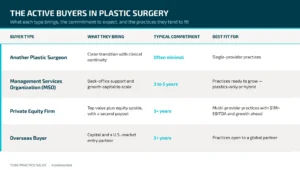
Buyers for a plastic surgery practice fall into a few groups, and the right one depends on where your practice is today: how many providers you have, how much you want to keep growing, and what you want your role to look like after a deal. Here is what each type brings.
Another Plastic Surgeon
When you’re the only surgeon in the practice, selling to another plastic surgeon or merging with a nearby group is often the most realistic path. It is a clean transaction with a buyer who already understands the clinical work, and it can be a strong fit when you want continuity for your patients and staff. These practices will be valued on a percentage of collections and are all-cash deals. It also helps to understand the math of why a doctor-to-doctor pathway is the most likely: most management services organizations and private equity platforms are looking for practices with more than one provider and over $2M in annual revenue. So a solo practice will often either transition to another surgeon directly or add providers first to open up those other options.
Management Services Organizations (MSOs)
If you have multiple providers in your practice, your options expand. For those plastic surgery practices, MSOs are increasingly interested in purchasing your business. An MSO takes on the non-clinical side of the business, such as billing, HR, marketing, and back-office operations, so you can focus on patient care, and it brings growth capital to help you add providers, locations, or services. Some MSOs are exclusively plastic surgery-centric, which appeals to surgeons who want a partner fully aligned with their specialty. Others are multi-specialty platforms that combine plastics with med spa, dermatology, or aesthetics under one roof. As the lines between those services keep blurring, hybrid practices that already run several service lines are an increasingly common target for these groups. This is also where we sometimes see exceptions to the single-surgeon practices. We recently represented a multi-location, single-surgeon plastic surgery group with a large medical aesthetics rollout that received interest from over a handful of buyers. We closed their deal at a $26M+ valuation, and they’re now expanding with their new partner.
MSOs value plastic surgery practices on a multiple of EBITDA, or earnings before interest, taxes, depreciation, and amortization. This is the profit number these groups build their offers on, and how they calculate it matters as much as the multiple they quote.
Private Equity Groups
Private equity has been one of the most active buyers in healthcare for years, and they will often pay the highest price on the board because your group will be their initial investment to build a platform / MSO. Like MSOs, these firms build their offers on EBITDA. They are more selective about the groups they partner with as they need a practice that can show consistent growth with operational sophistication. Many of the private equity firms seeking to partner with plastic surgery practices have built successful platforms in the dental industry, and are eager to replicate their success from that vertical to plastics.
You typically keep practicing for a five-year period or longer, with part of your compensation tied to the practice’s continued performance and often a meaningful equity stake that can pay out a second time when the platform sells again. A partnership with a private equity group can be a great fit for an entrepreneurial owner who is seeking to elevate their platform.
The Best Deal Is the Right Fit
Many of our clients at TUSK don’t chase the highest monetary offer because they understand the value of an aligned partner. For example, take a plastic surgery practice producing $3M a year, with significant cash-pay, and stuck between two strong offers: a clean all-cash $3M deal from a respected local surgeon, and an $6.3M MSO offer (assuming the practice produces $900K of EBITDA) with 75% cash at close, 25% in rolled equity, and a five-year commitment. The local deal is simpler and closes faster. The MSO partnership pays more up front, gives the surgeon equity that can pay out again when the platform sells, and comes with capital to add providers and grow. Both are good options. The right one depends on whether that surgeon wants to wind down or keep building, if the deal value meets their transition goals, and on which group fits the way they like to practice.
This is what TUSK does. We bring multiple offers to the table, and build comparison matrices so you’re able to compare each offer and buyer on the same playing field. This is your life’s work, and the decision is as much about culture and operational fit as it is about the number. With a clear picture of your financial goals, your work-life balance, and your vision for what comes next, the list of strong-fit buyers comes into focus quickly. My job is to help you understand every option, run a process that gets you full information, and match you with the partner who lets you monetize what you have built and keep practicing the way you want.
You owe it to yourself to understand all of your options and to be well represented in one of the most important transactions of your career. If you are even a few years out, it is worth knowing your number and getting familiar with the groups active in plastic surgery before you take that first call.
Frequently Asked Questions
How long does it take to sell a plastic surgery practice?
Most processes to sell your plastic surgery practice will run between nine and twelve months from preparation to close. Larger or multi-site practices can take longer. The timeline depends on how organized your financials are and how competitive the process is. In the deals we run at TUSK Practice Sales, we dedicate two weeks of focused prep up front that shortens the overall practice sales process. Our goal at TUSK is to allow you to continue providing exceptional clinical care, while we manage the sales process. Click here to learn more about the TUSK Practice Sales Proven Process.
Does my practice need to have more than one surgeon to attract an MSO or private equity buyer?
Usually, yes. Most MSOs and private equity platforms want more than one provider in a plastic surgery practice, because they have less key-provider risk at its center. Solo practices still have strong options, most often a sale to another surgeon, or they add providers first to open up platform buyers later.
Will selling change how I practice or treat my patients?
A good MSO or private equity partner takes over the business side, such as billing, HR, and marketing, so you can focus on clinical care, while clinical decisions stay with you. Get those specifics in writing before you sign, because every group operates a little differently.
How long do I have to keep working after I sell my plastic surgery practice?
With a private equity partner, plan on five years or more for a post-sale employment agreement. MSO commitments tend to run three to five years, and a sale to another surgeon can be shorter. The post-sale terms are negotiable, and your advisor will ensure you’re aligned with the compensation and timeline before you sign any binding piece of paperwork.